Mentoring at DRIVE: turning rural ideas into investment-ready ventures
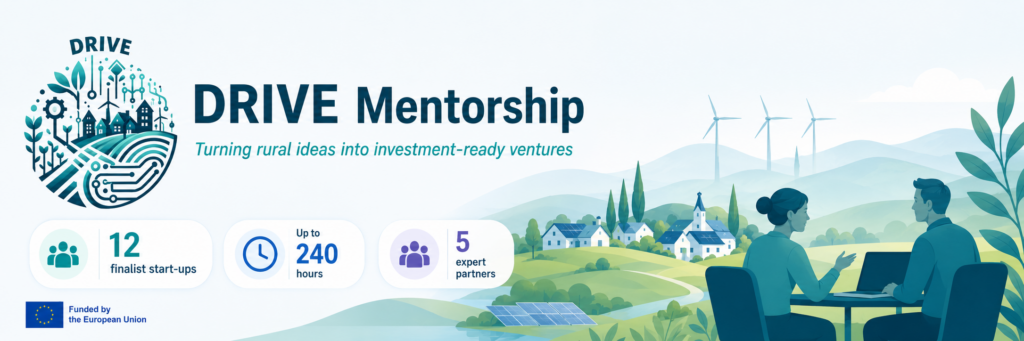
At the heart of DRIVE is a structured mentoring programme that takes the most promising founders from the Startup Village Roadshows and equips them to compete in Europe’s circular bio-based economy. Twelve finalist start-ups and teams, three from each rural village, receive up to 240 hours of tailored, one-to-one mentoring delivered by five expert partners across the consortium. The programme is built around five complementary modules, each led by a partner chosen for its specialist expertise, so that every founder leaves with a complete toolkit: a defensible business model, a funding strategy, a sharp investor pitch, and a clear route to market. The goal is concrete: by the end of the programme, each venture should have a business plan ready for investors, an application to a regional or European funding instrument, a polished pitch, or a place in a further acceleration programme.
Module 1: Sustainability and bio-based business models
This module helps founders build a business model that holds up commercially and environmentally. Working with Consorzio Italbiotec, the project coordinator and a leading Italian bioeconomy cluster, each team develops a complete and sound business model and plan for a circular, bio-based venture, defining its value proposition, resource flows and revenue logic. The aim is a model robust enough to take to investors and partners, where sustainability is the source of competitive advantage rather than a constraint.
Module 2: Social innovation for SMEs
The Center for Social Innovation (CSI) helps founders build social value into the venture itself, so that commercial growth and community benefit advance together. Teams work on linking their solution to local outcomes — jobs, skills and the revitalisation of the rural areas where they operate — and on positioning the venture within the wider community and stakeholder networks that DRIVE is building across Europe.
Module 3: Effective pitching and communication
AB Corporation works with each team on the practical craft of the pitch: structuring a clear narrative, presenting with confidence, and adapting the message for investors, corporate partners and customers. The module culminates in a polished pitch presentation and a shortlist of investor events where founders can deliver it, preparing them for the demo days, roadshows and cross-border networking that DRIVE creates.
Module 4: Investors and digital platforms
This module connects teams to the investment ecosystem. Founders learn how to identify the best opportunities and events to meet investors and pitch, and gain a working grasp of technical due diligence, what investors scrutinise and how to self-assess their own strengths and weaknesses before they are in the room. Teams also gain facilitated access through the F6S platform to the tools, contacts and services that move a venture from prototype to investable proposition.
Module 5: Access to finance and related funding
This module tackles the barrier that ranks highest for rural innovators: capital. Kliynteh Bulgaria mentors founders to identify the best funding opportunities at European, national and regional levels, including ERDF and regional cluster instruments, and European support such as the EIC and Invest Horizon, and to combine public backing with private investment into a coherent financing strategy. The intended result is a concrete application to at least one regional initiative or European financial instrument by the end of the programme.